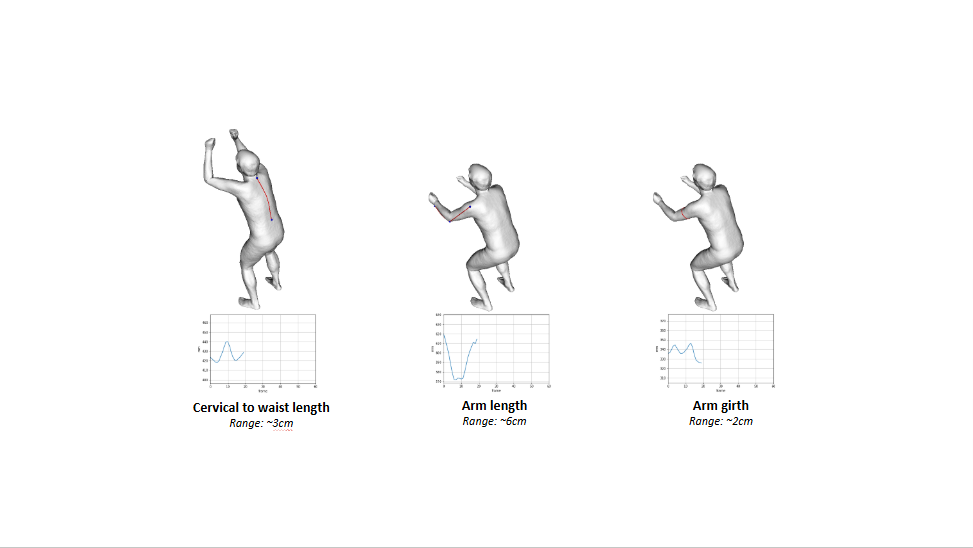
On 20–21 October 2026, Lugano, Switzerland, hosted the 17th edition of 3DBODY.TECH Conference & Expo, one of the leading international events dedicated to 3D and 4D body scanning technologies, digital anthropometry and human body data processing.
The event brought together researchers, companies and specialists from around the world to share advances and applications in fields such as ergonomics, healthcare, sports and product development.
The Instituto de Biomecánica (IBV) took part in this international event, showcasing its technological developments and the results of its research in digital anthropometry.
Among its contributions was a European study on children’s anthropometric and strength data, conducted in Spain and the Netherlands using MOVE4D body scanning technology.
3DBODY.TECH 2026: An international meeting point for body scanning research
The 2026 edition featured more than 80 scientific and technical presentations, covering topics such as:
- 3D and 4D scanning technologies,
- anthropometry,
- mobile scanning systems,
- body data processing, and
- applications across different industries.
The programme brought together research institutions, universities and companies specialising in human body digitalisation, providing a platform to share methodologies, experimental findings and practical applications.
As a technology centre specialising in the study of human behaviour and its interaction with products and environments, IBV took part in several conference activities, sharing its expertise in anthropometry, biomechanics and the development of body digitalisation technologies, including MOVE4D.
The event also provided an opportunity to present applications of digital anthropometry in large-scale research projects, where measurement accuracy, data consistency and the ability to adapt procedures to different populations are essential.
A european study to improve children’s anthropometric data
One of IBV’s main contributions to the scientific programme was a presentation by Sandra Alemany, Lead Researcher in Anthropometry and Body Scanning at IBV, entitled Harmonized Anthropometric and Strength Data of European Children for Standardization and Guidelines for their Effective Use.
The research addresses an important limitation in anthropometry. Reference data used for product design and standardisation have traditionally been based on adult populations and cannot be directly applied to children.
Throughout childhood and adolescence, body proportions and physical capabilities change considerably.
These changes are particularly significant in areas such as the head, hands and feet, and must be taken into account when designing products, equipment and environments for different age groups.
Another challenge is that existing European anthropometric databases differ in terms of:
- measurement methods,
- age groups covered, and
- variables recorded.
These differences make it difficult to compare and combine the available data.
To address these limitations, the European standardisation committee CEN/TC 122/WG 1 Anthropometry promoted a harmonised study of children’s anthropometric and strength data, jointly carried out in Spain and the Netherlands.
The project covered the full developmental range from infancy to adolescence and combined:
- traditional anthropometric measurements,
- digital body scanning,
- dedicated hand and foot scanning, and
- strength measurements.
Its aim was to obtain comparable information and establish common procedures that would support the use of these data in ergonomic design, safety assessment and product standardisation.
A methodology adapted to different age groups
One of the main challenges of the study was to develop suitable measurement protocols for children of different ages, taking into account their ability to cooperate, postural control and tolerance of measurement sessions.
The researchers established specific procedures for each age group, combining traditional instruments with body digitalisation technologies.
For younger children, measurements were organised into separate blocks to shorten sessions and make participation easier.
For older children, more comprehensive body and head scanning procedures could be used.
The study also included dedicated strength measurement devices, with instruments and accessories adapted to the participants’ body and hand dimensions.
Coordination between the teams in Spain and the Netherlands was essential to ensure that the results were comparable.
To achieve this, the researchers harmonised protocols for positioning, anatomical landmark identification, measurement acquisition and quality control.
The role of MOVE4D portable in the anthropometric survey
Body scanning technology played an important role in collecting anthropometric data throughout the study.
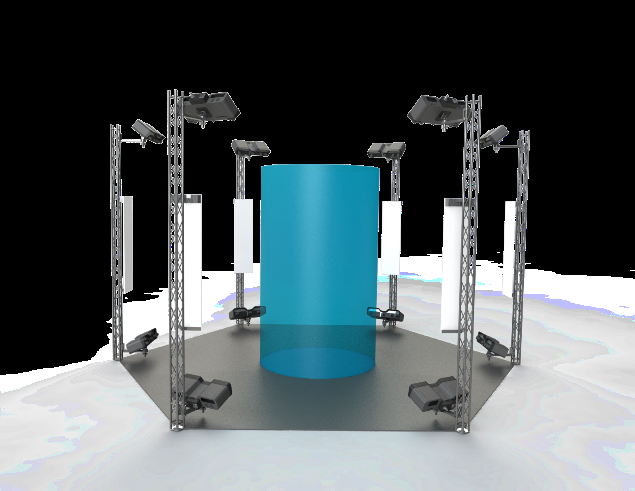
In Spain, MOVE4D portable was installed in more than 30 schools, allowing scans to be carried out directly at the survey locations rather than relying exclusively on fixed laboratory facilities.
This portability is particularly valuable for large-scale anthropometric studies, where data must be collected from many participants while maintaining consistent acquisition procedures.
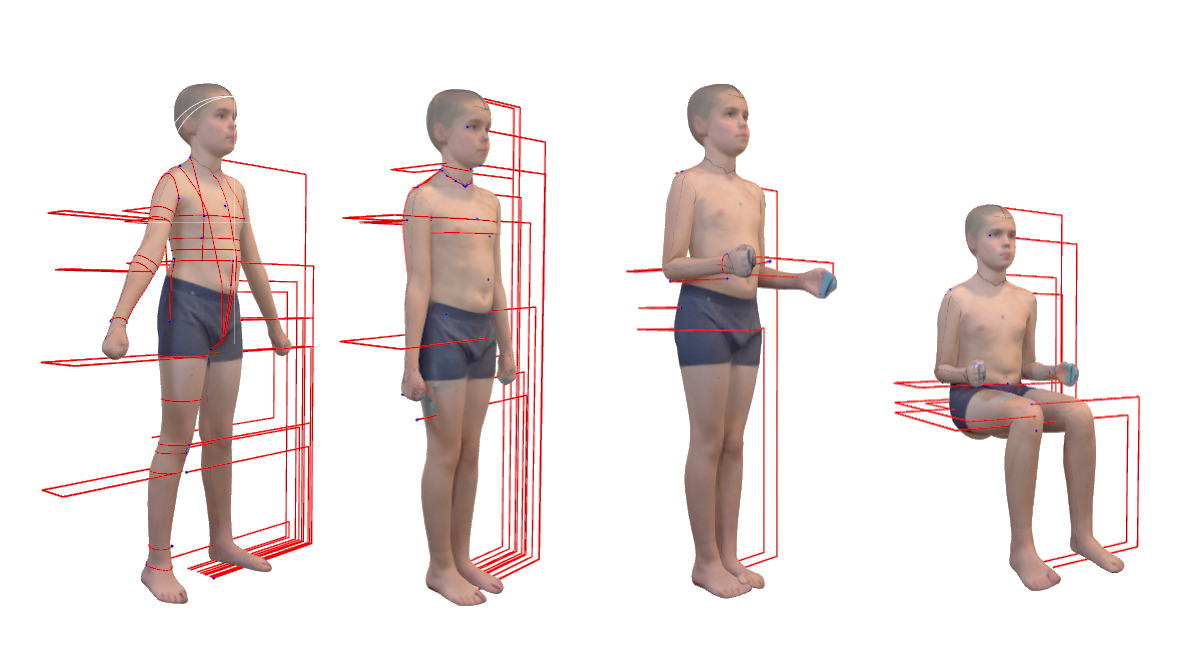
For children aged 4 to 16, body scanning systems, were used to obtain 104 body measurements and 14 head measurements.
The methodology was complemented by dedicated hand and foot scanners, as well as traditional measurements and strength tests.
Data processing was centralised at IBV to minimise potential differences arising from the use of different procedures and measurement algorithms.
In total, 17,712 2D and 3D scans were processed, following a workflow that included:
- scan preparation,
- artefact removal,
- anatomical landmark detection,
- digital body model processing, and
- measurement extraction.
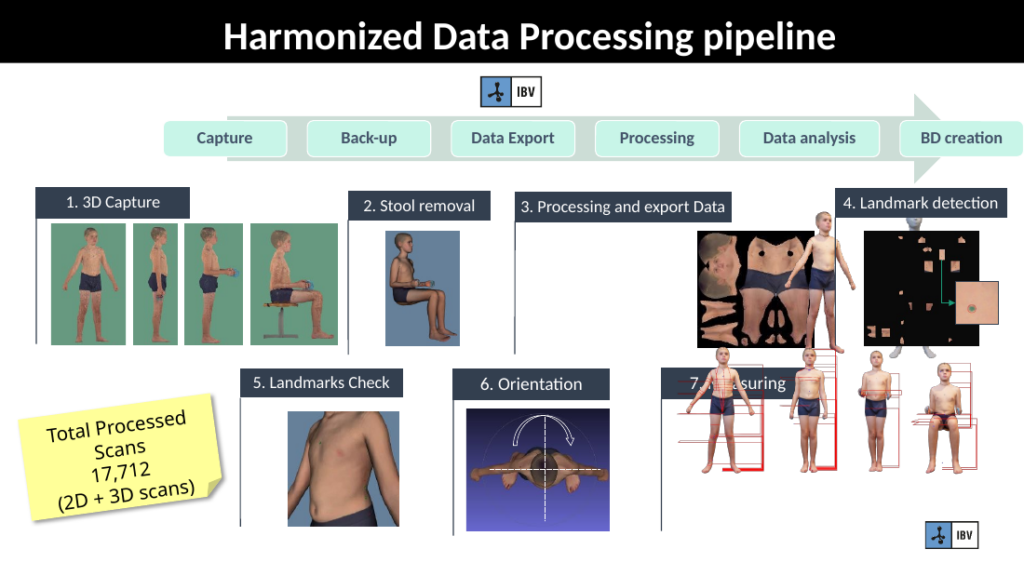
The use of common procedures made it possible to integrate information collected using different technologies and assess the compatibility between traditional and digital measurements.
This experience highlights the value of portable body scanning systems for anthropometric surveys, particularly when portability, operational efficiency and consistent data processing are essential.
Read our article: Mobile MOVE4D: Designed by researchers, optimized for large-scale anthropometric campaigns
From anthropometric data to new european reference standards
The project results have contributed to the development of new European references for the use of children’s anthropometric and strength data.
Two standardisation documents were among its main outcomes:
- CEN/TR 18296-1:2026, Ergonomics – Anthropometric and strength data of children in Europe – Part 1: Statistical summaries of the data, which provides reference statistical information.
- CEN/TS 18296-2:2026, Ergonomics – Anthropometric and strength data of children in Europe – Part 2: Guidelines for the correct application of anthropometric and strength data, which provides guidance on how to use this information correctly.
The documentation includes reference data on body dimensions, head, hand and foot measurements, as well as functional and strength measurements.
Beyond providing statistical data, the project establishes criteria for interpreting and applying this information, taking into account biological factors, posture, movement, clothing and human-product interactions.
These findings are relevant to manufacturers, researchers and standardisation specialists who need to account for children’s physical variability when designing products and assessing ergonomic and safety requirements.
Participation in 3DBODY.TECH 2026 provided an opportunity to share the results of a project that brings together anthropometric research, technological development and the practical application of body data.
The study presented by Sandra Alemany highlights the importance of harmonised data acquisition methods and digital tools capable of supporting the collection and processing of large volumes of anthropometric information.
In this context, MOVE4D provides body scanning and digital processing capabilities that can be integrated into anthropometric studies, biomechanics research and product development projects.
The work carried out in Spain and the Netherlands demonstrates how body digitalisation can help generate more comprehensive and comparable reference data, which can then be used to improve product design, ergonomics and safety.
At MOVE4D, we continue working to bring advances in 3D and 4D body scanning research into real-world applications, providing tools that help researchers and developers gain a more accurate understanding of human body shape and movement.
Discover how MOVE4D can be integrated into research projects and anthropometric studies.