For decades, apparel development has relied on anthropometric data to understand the human body.
Height, circumferences, lengths, proportions and body shapes provide the foundations for sizing systems, pattern development and the representation of different body types.
This information remains essential. But it comes with one limitation, it often describes the body at a specific moment in time, but the human body doesn’t remain still.
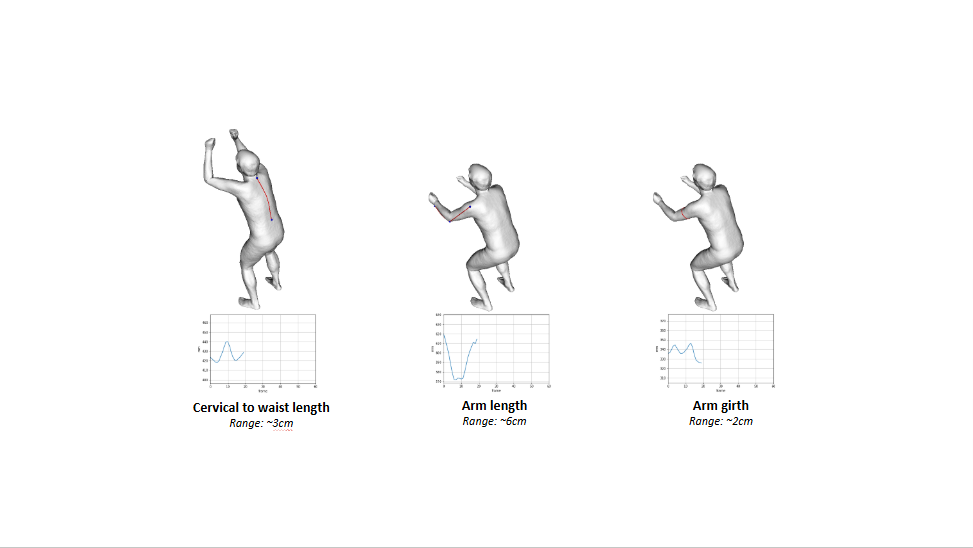
When we walk, raise our arms, sit, run or squat, our shape changes. Soft tissues deform, distances between anatomical areas vary, and the relationship between the body and the garment continuously evolves.
When it comes to apparel fit, a static representation of the body therefore tells only part of the story.
What can static body data tell us?
Anthropometric models provide essential information about individuals and populations.
Body measurements can be used to study size and shape variability, identify different morphotypes and develop sizing systems that better represent specific target populations.
In apparel development, this data helps answer fundamental questions:
- What are the dimensions of our users?
- How does body shape vary within our target population?
- Which sizes should we develop?
- How should patterns accommodate these differences?
However, many of these measurements are collected in controlled, relatively static postures.
As a result, they can describe what the body looks like, but not necessarily how it changes when it moves.
This distinction becomes particularly relevant for garments worn close to the body or products designed for activities involving significant movement.
Fit is not static
The fit of a garment is influenced by body measurements as well as body shape, personal fit preferences, pattern design, grading rules and the properties of the fabric.
There is also another variable that is more difficult to incorporate into conventional development processes, the movement.
As the body moves, areas such as the arms, legs, hips and torso can undergo significant changes in shape and dimensions.
A garment that performs well while a person is standing still may therefore behave differently once that person starts moving:
- Tension may appear in specific areas,
- pressure can increase,
- movement may become restricted,
- the garment,
- or the body underneath it may deform in ways that were not visible during a static assessment.
This is where dynamic body data introduces another layer of information into fit analysis.
From static body models to dynamic digital humans
MOVE4D simultaneously captures 3D body shape and movement
.
Instead of producing only a body representation at a single point in time, the system generates a consistent sequence of 3D models showing how body morphology evolves throughout a movement.
This makes it possible to analyse how those dimensions and shapes change over time.
MOVE4D can be used to:
- capture real human morphology,
- continuously track changes in body shape,
- quantify soft-tissue deformation,
- generate anatomically consistent digital human models,
- analyse body–garment interaction under dynamic conditions.
The system can capture full-body movement at up to 178 frames per second with sub-millimetre accuracy.
The result is a digital human model whose geometry evolves according to the real movement of the captured person.
Continue reading: 4D body scanning technology for apparel fit: MOVE4D Webinar
Static data model or 4D model?
It doesn’t necessarily have to be one or the other. Static anthropometric data remains fundamental for understanding populations, developing sizing systems and characterising morphological diversity.
A 4D model adds another question to the process: What happens to that morphology when the body starts moving?
The two approaches can be understood as complementary layers of information.
- A static model describes body dimensions and shape in a particular posture.
- A dynamic model adds information about how that shape evolves over time.
For designing some products, this additional layer can be particularly relevant.
Sportswear, compression garments, underwear and other close-fitting products are clear examples, as their performance depends strongly on how the garment interacts with a moving body.
Turning body data into product decisions
The real value of 4D models emerges when dynamic data can become part of the product development workflow.
Digital human models generated with MOVE4D can be integrated into leading garment simulation platforms, including CLO3D, Browzwear, Optitex and Style3D.
This makes it possible to work with different body types and evaluate garment behaviour under both static and dynamic conditions.
Developers can analyse factors such as tightness, looseness, gaps and material stretch, while comparing materials, designs or sizes using more objective metrics.
Instead, digital fit assessment can provide additional information earlier in the development process, helping teams identify potential issues and make better-informed decisions before subsequent physical validation.
Designing for real bodies means designing for bodies in motion
Body data has already helped the apparel industry build a much better understanding of human diversity.
The next challenge is incorporating something that is fundamental to the real wearing experience, the movement.
The human body is not a static mannequin. It moves, changes shape, deforms and adapts continuously.
4D body scanning provides a way to observe and quantify some of those changes, transforming movement itself into another source of data for product development.
It is also about understanding what happens to that body and to the garment around it, when it starts to move.
If you want to explore how dynamic body data could support your apparel development, fit assessment or research processes, get in touch with the MOVE4D team.
We can help you understand how 4D body scanning can be integrated into your workflow and what type of information it can provide for your specific application.