For biomechanics laboratories, sports science teams, clinical researchers and product innovation departments, marker-based motion capture has long been considered a reference method for analysing human movement.
Its accuracy is widely recognised, but it also has practical limitations. Markers must be placed on the body and sessions require expert preparation.
This raises an important question for the future of motion analysis: Can a markerless 4D body scanner provide accurate enough data for gait analysis? A scientific study published in Gait & Posture addressed this question by comparing MOVE4D, a 3D temporal scanning system, with a marker-based photogrammetry system during gait analysis.
The aim of this study was to assess whether 4D body scanning could provide comparable results while avoiding the need to instrument the subject with markers.
In this article, based on the study by Ana V. Ruescas Nicolau, Helios De Rosario, Fermín Basso Della-Vedova, Eduardo Parrilla Bernabé, M.-Carmen Juan and Juan López-Pascual, the author explains how MOVE4D was tested, what the results showed and why this matters for markerless motion capture.
Find out more about this scientific study
How accurate was MOVE4D?
In the reference posture, the differences in 3D landmark positions between MOVE4D and the marker-based system were between 1.9 and 2.4 mm.
During gait, errors increased, as expected in dynamic conditions, but remained within a relevant range for biomechanical motion analysis.
The study also found that the differences between both systems were smaller than the usual errors associated with manual marker placement and soft-tissue artefacts.
This supports the use of 4D body scanning as a markerless alternative for gait analysis, especially when need to be balanced:
- accuracy,
- subject comfort,
- and scalability.
Why does accuracy matter in markerless motion capture?
Markerless motion capture is attractive because it removes one of the most time-consuming and operator-dependent steps in traditional biomechanics, placing markers on the subject.
Without markers, measurement sessions can be:
- faster,
- more comfortable,
- and easier to repeat.
This is valuable in sports performance, clinical follow-up, rehabilitation research, and product testing.
However, removing markers also introduces a challenge. For a markerless system to be useful in biomechanics, it must produce measurements that can be trusted.
The paper highlights this challenge clearly, combining the accuracy of marker-based stereophotogrammetry with the usability of markerless movement analysis is difficult.
You might be interested in: Saddle height cycling and bike fitting: what 4D motion analysis reveals about hip and knee kinematics
Previous analysis: validating anatomical landmarks on homologous meshes
Before assessing MOVE4D during gait, it was necessary to validate a previous step, whether anatomical landmarks could be reliably identified on homologous meshes.
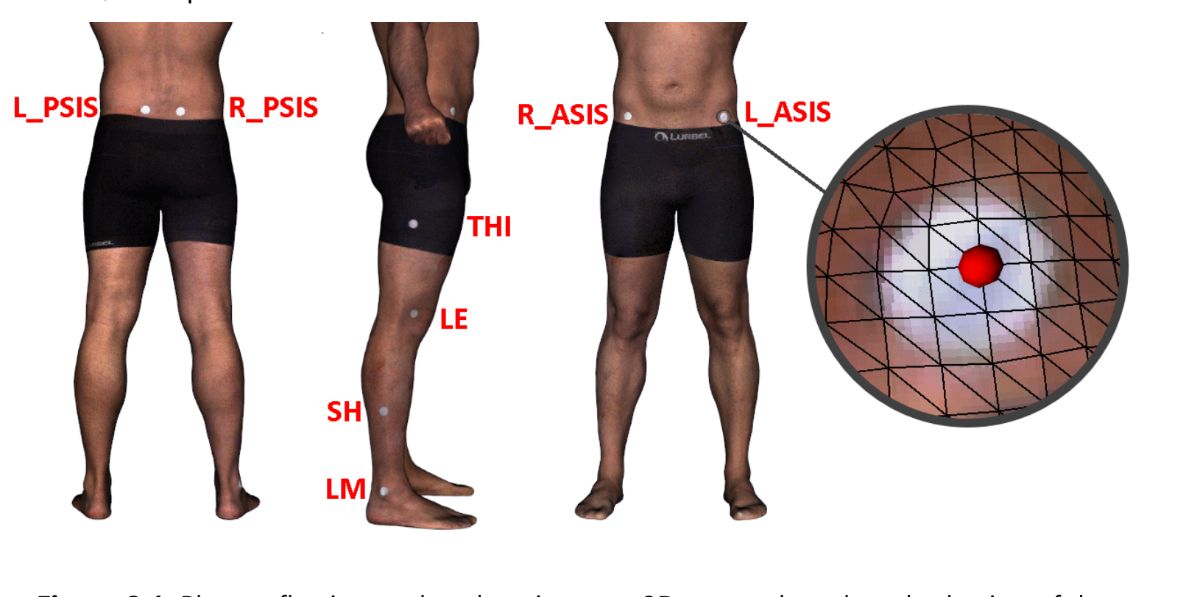
This matters because gait analysis depends on anatomical references. In traditional motion capture, those points are usually defined by placing markers on anatomical landmarks.
In a 4D body scanning workflow, the objective is to identify equivalent anatomical points on the digital body mesh.
A previous study, Positioning errors of anatomical landmarks identified by fixed vertices in homologous meshes, analysed whether fixed vertices of a homologous mesh could identify anatomical landmarks with accuracy comparable to manual palpation.
The study used 3,165 human shape scans from the CAESAR dataset and assigned mesh vertices to 53 anatomical landmarks.
The results showed that, for most landmarks, location errors were comparable to those obtained by manual palpation. This provided the basis for the next step, testing MOVE4D in dynamic gait analysis.
Find out more about the study here
How was MOVE4D’s accuracy tested?
The experiment compared two systems:
- a marker-based stereophotogrammetry system;
- a 3D temporal scanning system, MOVE4D.
The study was conducted in the Human Analysis Laboratory of the Instituto de Biomecánica (IBV).
The marker-based system used 16 infrared cameras to capture the 3D position of markers attached to the body.
MOVE4D used 16 camera modules to record the 3D point cloud and colour information of the whole body in motion. Both systems were calibrated with a shared coordinate system and configured to record at 30 frames per second.
Twelve healthy adults participated in the study. Each subject was recorded in a static standing posture and during two gait measurements.
The gait measurements were performed in an 8-metre corridor, with participants walking at a comfortable speed.
What were the main results?
The study analysed 24 gait cycles in total. The comparison focused on landmark position errors and joint angle differences between the marker-based system and MOVE4D.
1. Static landmark position accuracy
In the reference posture, 3D landmark position differences were between 1.9 and 2.4 mm. The statistical tests showed no significant deviation between the calibration frames of both systems.
For a markerless motion capture system, this is a key result. It shows that the system can identify anatomical references with a level of precision compatible with biomechanical analysis.
2. Dynamic marker position errors during gait
Movement adds complexity. During gait, the body is no longer static, soft tissue moves and tracking anatomical points becomes more demanding.
The study found that marker coordinate differences during motion were between 1.6 and 2.2 times greater than in static conditions. This increase was statistically significant in the medial-lateral and vertical directions.
|
Direction |
Static error | Dynamic error |
|
Anterior-posterior |
2.40 mm |
3.91 mm |
|
Medial-lateral |
1.89 mm |
3.74 mm |
| Vertical | 2.14 mm |
4.80 mm |
Table 1. Static and dynamic marker coordinate differences between marker-based photogrammetry and 3D temporal scanning.
These results show that dynamic movement increases measurement differences, but the errors remained within a range that supports the use of 3D temporal scanning for gait analysis.
How accurate were the joint angle measurements?
The study also compared throughout the gait cycle:
- hip,
- knee,
- and pelvic angles.
The smallest differences were found in pelvic angles and flexion-extension joint angles, with maximum values below 3°. The greatest errors were observed in hip axial rotation, followed by knee lateral flexion and knee axial rotation.
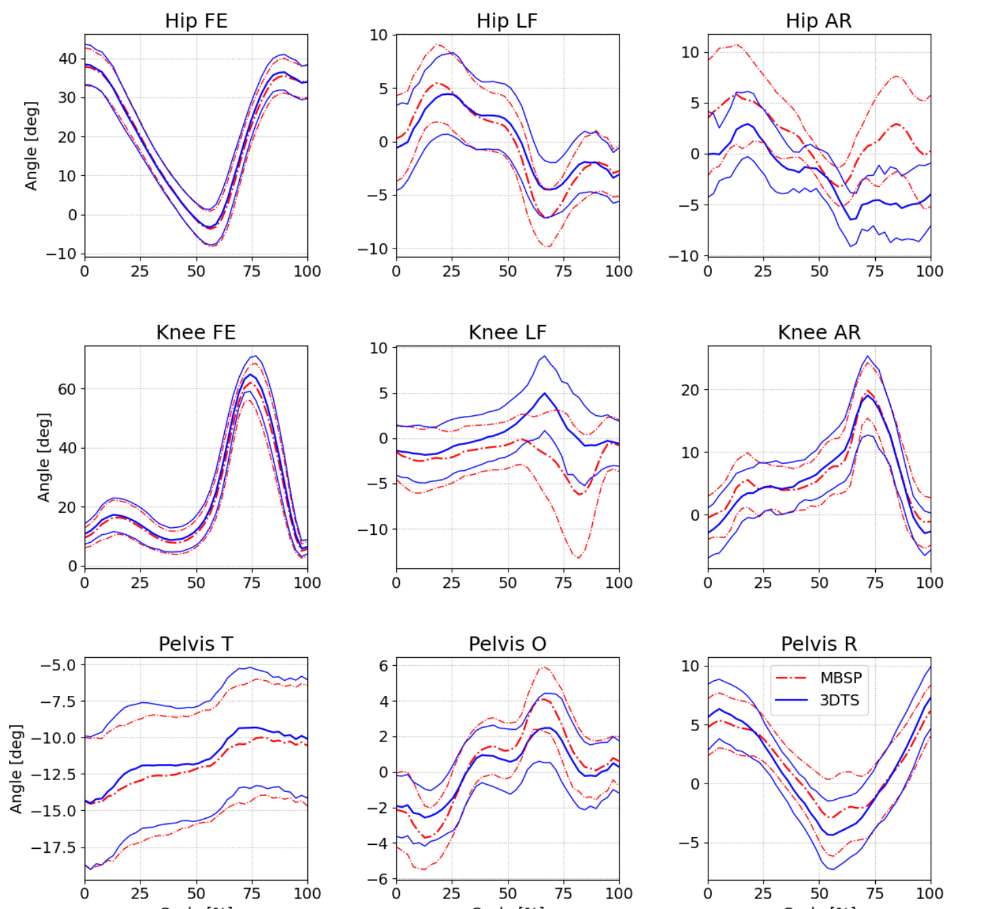
The figure shows that the curves obtained with both systems follow comparable patterns during gait. This demonstrates that MOVE4D can provide meaningful kinematic information.
|
Biomechanical variable |
Mean RMS error |
| Hip flexion-extension | 1.26° |
| Hip lateral flexion | 1.65° |
| Hip axial rotation | 5.76° |
| Knee flexion-extension | 1.98° |
| Knee lateral flexion | 3.51° |
| Knee axial rotation | 3.62° |
| Pelvic tilt | 0.90° |
| Pelvic obliquity | 1.15° |
| Pelvic rotation | 1.19° |
Table 2. Mean RMS joint angle errors between marker-based photogrammetry and 3D temporal scanning.
The lowest errors were found in pelvic and flexion-extension variables. The highest error was found in hip axial rotation, which is consistent with the broader challenge of measuring transverse plane rotations in motion capture.
What does this mean for markerless motion capture?
The study shows that 3D temporal scanning can provide results close to those obtained with marker-based photogrammetry when equivalent protocols and processing methods are used.
The paper states that the differences between the 3D temporal scanner and the marker-based system were smaller than the usual errors caused by manual marker positioning and soft-tissue artefacts.
It also supports 3D temporal scanning as a promising alternative to traditional marker-based motion capture.
This is important for anyone searching for:
- accuracy 4D body scanner,
- accuracy 4D motion capture system,
- accuracy markerless motion capture,
- markerless gait analysis accuracy.
The answer is not that all markerless systems perform the same way. RGB-only systems, IMUs and 4D body scanners capture different types of data.
MOVE4D’s advantage lies in capturing the full body surface in motion and generating high-density meshes that can be tracked over time.
Don’t miss our article on: Functional ACL assessment using dynamic body surface analysis
Why does full-body surface capture matter?
Traditional marker-based systems track selected markers. RGB-based markerless systems estimate body keypoints from images. A 4D body scanner captures the body surface in motion.
High-density meshes make it possible to analyse changes in position, in body shape and surface deformation.
This opens possibilities beyond conventional gait analysis, including:
- soft tissue behaviour,
- segment volumes,
- functional asymmetries,
- apparel fit,
- and human-product interaction.
For biomechanics, sports science, rehabilitation, apparel and product development, this means that movement analysis can become more complete, less invasive and easier to repeat.
Key ideas from the study
The study provides scientific evidence that MOVE4D can be used as a markerless system for gait analysis with results comparable to marker-based photogrammetry.
The main takeaways are:
- MOVE4D was directly compared with a marker-based photogrammetry system.
- Static landmark position differences were between 1.9 and 2.4 mm.
- Dynamic errors increased during gait but remained within a relevant range.
- Pelvic angles and flexion-extension variables showed the smallest differences.
- Hip axial rotation was the most challenging variable.
- 4D body scanning also captures the full body surface in motion.
For organisations looking for an accurate 4D motion capture system, the value of MOVE4D is combining markerless usability with validated biomechanical measurement.