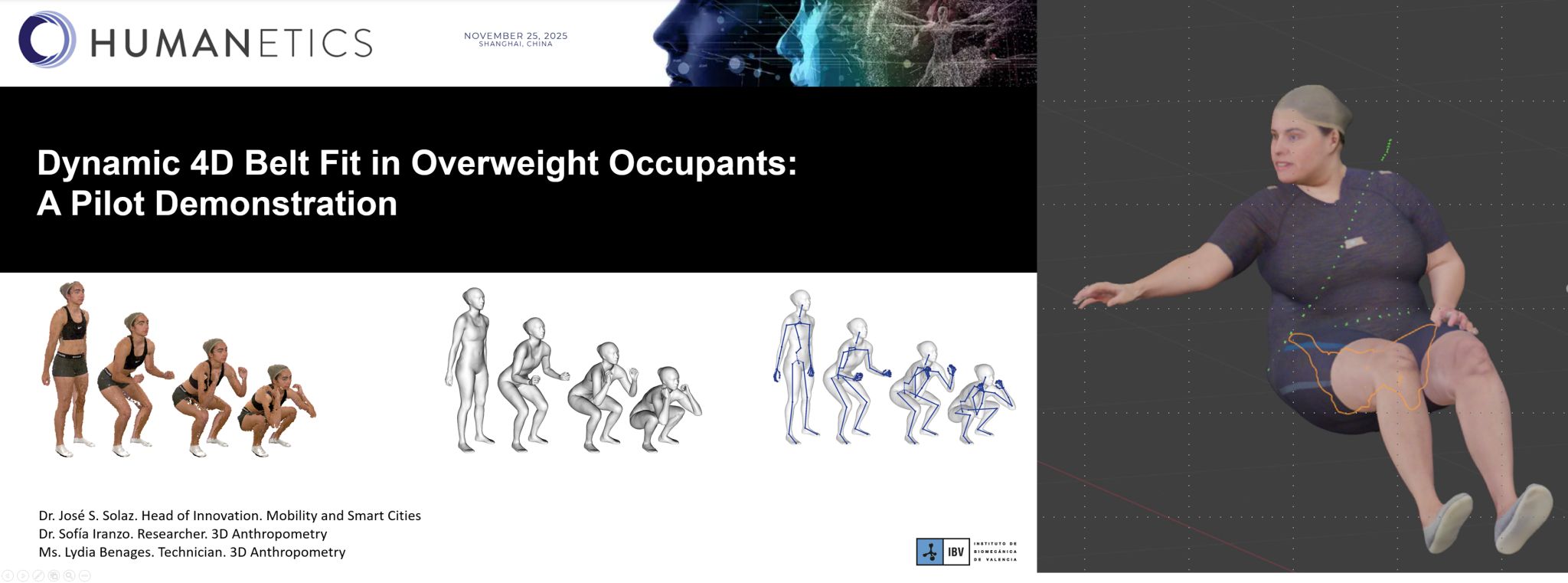
The Instituto de Biomecánica (IBV) took part as a Special Guest in the Humanetics User Meeting and Workshop 2025, held in November in Shanghai.
At this international forum, Dr. José Solaz, Head of Innovation at IBV, presented a pioneering demonstration on seatbelt positioning in occupants with different body compositions.
Dynamic 4D Belt Fit in Overweight Occupants: a pilot demonstration
During the event, IBV showcased the results of the study “Dynamic 4D Belt Fit in Overweight Occupants”, focused on the capabilities of the MOVE4D technology to dynamically analyze the interaction between the seatbelt and occupants with different BMI (Body Mass Index).
To achieve this, the team developed a SUV seat mock-up equipped with a three-point seatbelt compliant with the UNE ECE R16 regulation.
An XSENSOR pressure-mapping system was placed on the seat and, combined with MOVE4D data, enabled accurate estimation of pelvic position.
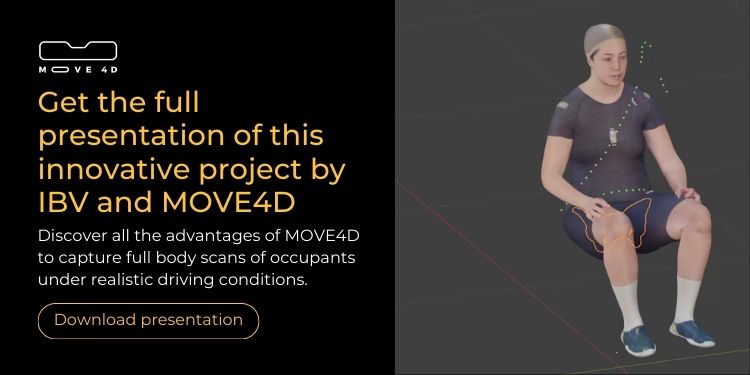
4D reconstruction of the safety belt path
The system incorporates a marker and tracking setup capable of reconstructing in 4D both the belt’s shape over the occupant, the body shape of the occupant, and the real path of the belt during representative maneuvers that can occur during driving.
This makes it possible to simultaneously analyze body geometry and belt interaction during movement.
Discover other projects in which MOVE4D has been involved: MOVE4D and LI-NING drive innovation in sportswear design with a new 4D body scanning lab in China
Results: Significant differences based on body mass index.
Occupant characteristics
The study compared two individuals (women) with the same height but with different BMI (one with average weight and another with obesity type II), who tested the seat with two different backrest inclinations emulating a sequence of movements.
Implications for restraint system safety
The results reveal:
- Notable differences in how the belt engages with the pelvis and abdomen, as well as greater displacement of the thoracic belt segment in the participant with a higher BMI.
This behavior could compromise the effectiveness of the restraint system under certain conditions.
- The combination of homologous 4D body meshes, pressure maps and precise belt tracking provides an unprecedented level of detail in analyzing body–belt interaction, especially the behavior of soft tissue.
This approach opens the door to new opportunities for designing restraint systems that are safer and more representative of real-world occupants.
IBV strengthens its position as an international leader in 3D/4D anthropometry applied to automotive safety
IBV’s participation in the Humanetics User Meeting and Workshop 2025 reinforces its position as a global reference in advanced 3D/4D anthropometry technologies applied to the automotive sector.
To explore more examples of how MOVE4D technology is applied across different domains, we invite you to visit the MOVE4D website sections where we showcase real-world use cases and advanced 4D capture and analysis solutions.
Want to learn more about MOVE4D or connect with us? Reach out and our team will support you throughout the entire process.